
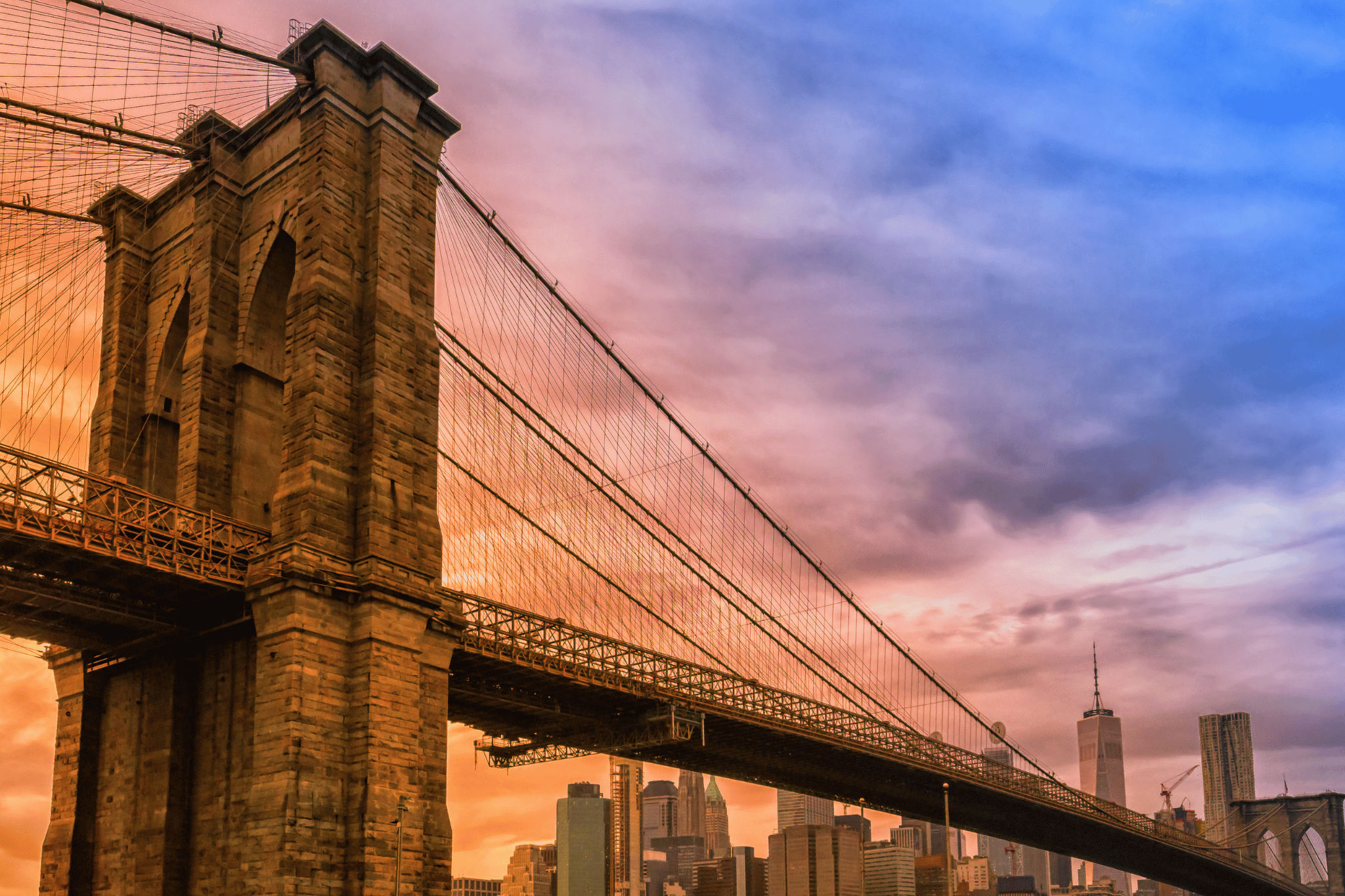
New York’s Brooklyn Bridge is one of those structures that stops you mid-step, even if you’ve seen it a thousand times in photos. Stretching across the East River between lower Manhattan and Brooklyn, this 1883 suspension bridge still carries roughly 150,000 vehicles and pedestrians every single day. Whether you’re planning your first crossing or your fiftieth, here’s everything you need to know.
Key Takeaways
- The Brooklyn Bridge opened on May 24, 1883, and was the first bridge to use steel cable wire in its construction.
- Walking across takes about 25 to 40 minutes, and the experience is completely free.
- The Manhattan side entrance is at Park Row and Center Street, while the Brooklyn side entrance is near Boerum Place and Tillary Street.
- Nearby neighborhoods like Brooklyn Heights and DUMBO make excellent starting or ending points for your walk.
Ready to explore New York City from a stylish home base? Browse CozySuites apartments and condos in New York and book your stay today.
The History Behind the Iconic Brooklyn Bridge
How the Brooklyn Bridge Began
Before the bridge existed, the only way to travel between Manhattan and Brooklyn was by ferry across the East River. In harsh winter conditions, ice could shut down ferry service entirely, leaving thousands of commuters stranded. The need for a permanent crossing was obvious, and by the mid-1860s, plans were already in motion.
In 1867, New York legislators approved a bold plan for a suspension bridge designed by a German-born engineer named John Roebling. His bridge designs were already proven. He had successfully constructed suspension bridges over Niagara Falls and the Ohio River in Cincinnati.
The project was massive in scope. The Brooklyn Bridge began construction in 1869, and it would take 14 years, cost $15 million (over $320 million in today’s dollars), and claim the lives of at least 20 workers before it was completed.
John Roebling and the Original Vision
John Roebling envisioned something the world had never seen: the first bridge built with steel cable wire. His bridge would span 1,595 feet from tower to tower, making it the longest suspension bridge on the planet at the time.
Roebling’s vision went beyond simple engineering. He designed a broad pedestrian promenade elevated above the roadway, predicting it would be “of incalculable value” in a crowded commercial city. That promenade remains one of the bridge’s most beloved features today.
Tragically, John Roebling never saw his masterpiece completed. Just before construction began in 1869, a boat crushed his foot while he was taking compass readings along the East River. He died of tetanus three weeks later.
Washington Roebling Takes Over as Chief Engineer
After his father’s death, 32-year-old Washington Roebling stepped in as chief engineer. He had worked alongside his father on previous bridge projects and had helped develop the bridge’s design.
The construction process was grueling and dangerous. To build the bridge’s foundations, workers called “sandhogs” excavated the riverbed inside massive wooden chambers called caissons. These airtight boxes were pinned to the river floor by granite blocks, with pressurized air pumped in to keep water out.
The caissons reached a depth of 44 feet on the Brooklyn side and 78 feet on the Manhattan side. The work took a devastating physical toll on the laborers and on Washington Roebling himself.
Caisson Disease and Decompression Sickness
Workers inside the caissons experienced a mysterious and painful condition known as caisson disease, which we now understand as decompression sickness. As sandhogs traveled between the pressurized underwater environment and ground level, dissolved gases in their blood expanded rapidly, causing excruciating joint pain, paralysis, and sometimes death.
More than 100 workers suffered from decompression sickness during bridge construction. Washington Roebling was among them. The condition left him partially paralyzed, and he was confined to his apartment in Columbia Heights, Brooklyn, where he watched construction through a telescope.
Pro Tip: If you visit the Brooklyn Heights Promenade, you’re standing near where Washington Roebling observed construction progress from his apartment window.
Emily Warren Roebling: The Woman Who Finished the Bridge
With Washington Roebling unable to visit the site, his wife Emily Warren Roebling became the critical link between the chief engineer and the construction crew. She relayed Washington’s instructions, studied engineering concepts, and developed expertise in materials, stress analysis, and cable fabrication.
Emily’s role was so central that many people assumed she was the true chief engineer. On opening day, she was given the honor of the first carriage ride across the completed bridge, carrying a rooster in her lap as a symbol of victory.
Her contributions broke ground in more ways than one. Emily Warren Roebling is now recognized as one of the most important figures in 19th-century engineering history.
Engineering Marvels: What Makes the Bridge Special
The Main Span and Masonry Towers
The Brooklyn Bridge’s main span stretches 1,595 feet (486 meters) between its two massive masonry towers. When it was completed in 1883, it was the longest suspension bridge in the world, holding that record until 1890.
The towers themselves rise about 276 feet above the water and are constructed from limestone, granite, and cement. Their Gothic arches have become one of the most photographed features of the New York City skyline and a defining New York City landmark.
Four Main Cables and Steel Innovation
The bridge is supported by four main cables, each made of 19 individual strands containing 278 separate wires. This was the first time steel cable wire was used in bridge construction, a revolutionary leap forward in engineering.
| Feature | Detail |
| Main Span | 1,595 feet (486 meters) |
| Total Length | Approximately 6,016 feet (1,834 meters) |
| Tower Height | 276 feet above water |
| Main Cables | 4 cables, each with 19 strands of 278 wires |
| Material | Steel wire (first of its kind) |
| Construction Period | 1869 to 1883 |
| Cost | $15 million ($320M+ adjusted) |
The Deck, Roadway, and Original Layout
When the bridge opened, the deck was divided into separate sections. The center featured the elevated pedestrian promenade, while the outer portions carried horse-drawn vehicles and trolley tracks for railroad cars. Two lanes on each side handled vehicular traffic.
Over the decades, the roadway has evolved significantly. The trolley tracks were removed, and the bridge was reconfigured for automobile traffic. Today, the structure carries vehicles on the lower roadway and dedicates the upper deck to pedestrian traffic and cyclists.
Bridge’s Stability and Legacy
Questions about the bridge’s stability arose almost immediately after it opened. On May 30, 1883, just six days after opening day, a stampede on the bridge killed 12 people after someone shouted that the structure was collapsing. It wasn’t.
To prove the bridge was safe, circus showman P.T. Barnum famously led 21 elephants across the span on May 17, 1884. The stunt worked, and public confidence was restored.
The Brooklyn Bridge was designated a national historic landmark by the National Park Service, and it remains one of the most celebrated feats of 19th-century engineering in the world. Engineers still study its construction methods and innovative use of steel.
Walking the Brooklyn Bridge: A Visitor’s Guide
Manhattan Side vs. Brooklyn Side Entry Points
You can start your crossing from either side of the bridge. Here’s a quick comparison to help you decide.
| Manhattan Side | Brooklyn Side | |
| Entrance Location | Park Row and Center Street (near City Hall) | Boerum Place and Tillary Street |
| Nearest Neighborhood | Lower Manhattan / City Hall area | Downtown Brooklyn / Brooklyn Heights |
| Views Walking Toward | Brooklyn skyline, DUMBO, Brooklyn Heights | Manhattan skyline, One World Trade Center |
| Crowd Level | Tends to be busier at the start | Slightly less crowded |
| Nearby Transit | Brooklyn Bridge-City Hall subway station | High Street station (A/C lines) |
Most visitors prefer starting from the Manhattan side because the walk toward Brooklyn offers stunning views of the Manhattan skyline behind you. But starting from the Brooklyn side means you’ll be walking toward lower Manhattan with the skyline growing larger in front of you.
Pro Tip: For the best photos of the masonry towers with the Manhattan skyline as a backdrop, start your walk from the Brooklyn side early in the morning before the crowds arrive.
What to Expect on the Crossing
The pedestrian promenade sits above the roadway, so you’re elevated with clear sightlines in every direction. The walk spans roughly 1.1 miles and takes about 25 to 40 minutes, depending on your pace and how often you stop to take photos.
Pedestrian traffic can get heavy, especially on weekends and during the summer months. Stay on the pedestrian side of the path (the lanes are marked) and keep moving if you’re not stopping for photos. Cyclists share the deck, so stay aware of your surroundings.
The bridge is open 24/7, and the crossing is completely free. Sunset and sunrise walks are particularly popular because of the way light hits the towers and cables.
What to See Near the Bridge
Once you’ve finished your walk, both sides of the bridge offer plenty to explore.
On the Brooklyn Side:
- DUMBO (Down Under the Manhattan Bridge Overpass): Home to the famous Washington Street photo spot, where you can frame the Manhattan Bridge between brick buildings.
- Brooklyn Heights Promenade: A tree-lined walkway with panoramic views of the Manhattan skyline and the East River.
- Brooklyn Bridge Park: A sprawling 85-acre waterfront park perfect for unwinding after your walk.
- Time Out Market Brooklyn: A food hall with local vendors and rooftop views.
On the Manhattan Side:
- City Hall Park: A green oasis right at the bridge’s entrance near Park Row.
- South Street Seaport: A historic district with shops, restaurants, and waterfront access.
- One World Trade Center: Just a short walk south through lower Manhattan.
- Chinatown and Little Italy: A quick stroll north from the bridge entrance.
Getting There and Nearby Access
The bridge is accessible from several transit options. On the Manhattan side, take the 4, 5, or 6 train to Brooklyn Bridge-City Hall station. On the Brooklyn side, the A or C train to High Street station drops you close to the entrance.
If you’re driving, keep in mind that the bridge connects to the FDR Drive on the Manhattan side. Street parking is limited in both areas, so public transit is your best bet.
The bridge approaches on either end connect to local streets and approach ramps that feed into the surrounding neighborhoods. From the Brooklyn side, you can easily walk to Brooklyn Heights or head toward the waterfront plaza areas in DUMBO.
Where to Stay Near the Brooklyn Bridge
If you’re visiting New York and want to be close to the action, staying in a comfortable apartment or condo beats a cramped hotel room every time. CozySuites offers vacation rentals in New York that give you the space of a home with the reliability of a hotel.
You’ll have a full kitchen, a comfortable living area, and a stylish space to come back to after a long day of exploring the city. It’s the kind of setup that makes a NY trip feel less like a vacation and more like actually living in the city for a few days.
FAQ
Can you walk across the Brooklyn Bridge for free?
Yes, walking across the Brooklyn Bridge is completely free and available 24 hours a day, 7 days a week. The pedestrian promenade is elevated above the roadway, giving walkers unobstructed views of the East River, the Manhattan skyline, and the Brooklyn waterfront. No tickets or reservations are required.
Where are the bridge approaches and entrance points?
The Manhattan side entrance is located at Park Row and Center Street, directly across from City Hall. On the Brooklyn side, the main entrance is where Boerum Place meets Tillary Street. Both bridge approaches connect to local streets and approach ramps that lead into surrounding neighborhoods. The entrances are well-marked and accessible by subway on both ends.
Did the Brooklyn Bridge originally have trolley tracks?
Yes, when the bridge opened in 1883, it included trolley tracks for railroad cars along with separate lanes for horse-drawn vehicles and pedestrians. The trolley tracks were eventually removed as the bridge was reconfigured over the 20th century to accommodate automobile traffic. Today, the deck is divided between motor vehicles on the lower roadway and pedestrians and cyclists on the upper level.
What was the role of the Brooklyn Daily Eagle in the bridge’s history?
The Brooklyn Daily Eagle, one of Brooklyn’s most prominent newspapers during the 19th century, played a significant role in documenting the construction and public debate surrounding the bridge. The paper covered construction milestones, worker safety concerns, and the political negotiations that shaped the project. It served as a primary news source for Brooklyn residents following the bridge’s progress over its 14-year construction period.
What is the best photo spot near the Brooklyn Bridge?
One of the most popular photo locations is on Washington Street in DUMBO, Brooklyn, where you can capture the Manhattan Bridge framed between two brick buildings with the Empire State Building visible in the distance. For shots of the Brooklyn Bridge itself, head to Brooklyn Bridge Park or the Brooklyn Heights Promenade, both on the Brooklyn side. Early morning visits at ground level offer the best light and smallest crowds.
Does CozySuites offer houses or cabins near the Brooklyn Bridge?
CozySuites does not offer houses or cabins. We exclusively provide apartments and condos in New York and other major cities. Our New York vacation rentals are stylish, fully furnished, and conveniently located for exploring landmarks like the Brooklyn Bridge and the surrounding neighborhoods.
